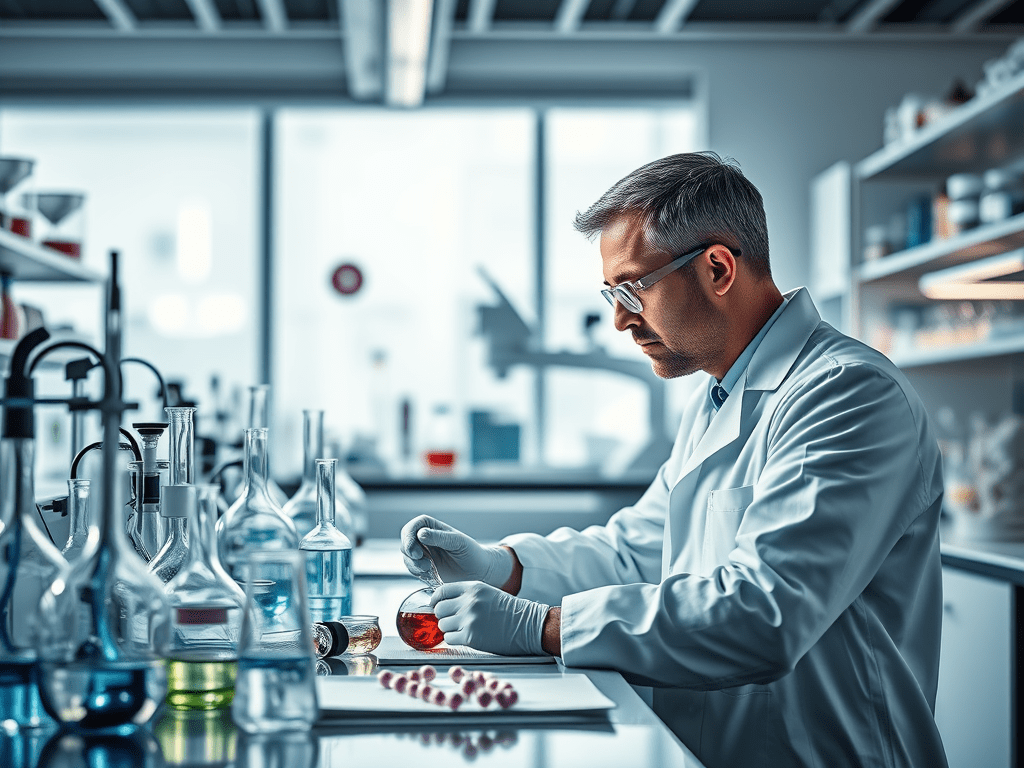
Have you ever wondered how these tiny pills or colorful liquid syrups that doctors prescribe reach you? These medications take a fascinating journey. Coming from a research background, I can tell you—it’s an immense, demanding, and undeniably very captivating journey.
Let us explore more about drug development
When we talk about “drug development,” it’s not just randomly mixing up a few chemicals and passing them out. It takes more than we think. It’s akin to a marathon. It takes more than 10 years to find a suitable drug molecule. This molecule will cure an illness. It involves billions of dollars to bring medicines to market to cure disease. The backstory of each drug lays out a story of teamwork, incalculable botches, and firm fortitude.
- Ideation: The journey begins from the lab with a big idea to find a cure for a specific disease. Many scientists and researchers collaborate closely. They search for that one molecule from plants, microbes, or bacteria. Alternatively, they design it using advanced computational technologies. This is a preliminary stage where the question is “Does this molecule help fight the disease?” It is like finding one specific molecule from an ocean full of possibilities. Only a handful of ideas look promising, and with that begins the journey of drug development.
- Second stage: After selecting a few handfuls of molecules, these are further tested for their safety. This phase is called Pre-clinical studies. During this phase the molecules are assessed using various experiments in the laboratory. These molecules are further tested on animals to check their safety and effectiveness. This stage answers, “Does this work? Is it safe?” This step is crucial. The number of molecules is reduced significantly, and only those specific ones will move to a later stage.
- Third Stage: The next stage is called the clinical phase. The survival molecule from the preclinical phase gets the chance to be tested on diseased and healthy volunteers. These individuals are grouped into different clusters, and these clusters range from 10 to a few hundred. This phase is divided into different sub-phases. It includes phase 1, where the molecule is tested on a small group. In phase 2, the molecule is tested on a slightly bigger group. Finally, phase 3 tests the molecule on a group containing thousands of individuals to assess its safety. Each phase here acts like a filter; only the safe and effective drug moves through it.
- Fourth stage: Once all the testing is finished, the next step is to get approvals. This is one of the tough and perplexing steps in the drug discovery. Companies must send all the data collected from the experiments to the higher regulatory authorities. These authorities are like headmasters. They check and verify the results before saying “Tested OK” for public use. Each nation has its own specific regulatory authorities. For example, the European Medicines Agency (EMA) serves European nations. The Central Drugs Standard Control Organization (CDSCO) is for India. The Food and Drug Administration (FDA) is for the US. Many other lists go on.
- Fifth stage: Now, once the molecule, which can be called a “drug,” is produced on a large scale in factories. Again, the drug is tested for its quality. This is done by companies to make sure the entire batch is the same and safe.
Once the drug is produced and marketed, it is still under surveillance by scientists and doctors for any side effects. This phase is like a “trial in the real world.” This is how a drug is developed to fight an illness. Yet, the story never really ends here. That drug is still being watched. It is subjected to constant upgrades to form its better version.
So the next time, when you have medicines, remember it’s the result of years of hard work. Experiments, many of which failed, and constant diligence have contributed. All the efforts of researchers have just reached you in the form of a pill. Let me conclude my post. I want to ask you a quick question. If you were a researcher, which part of this journey would you be involved in?
 Jigyasa with Pharma